One tenant, always
Your own copy. There is no shared database holding your records next to someone else's.
KickSide/Use cases/Regulated industries
Legal, finance, health, insurance, EU. You want what AI can do and you can't hand your client list to a vendor. KickSide runs on infrastructure you control, one company per copy, with a record of everything an agent did.
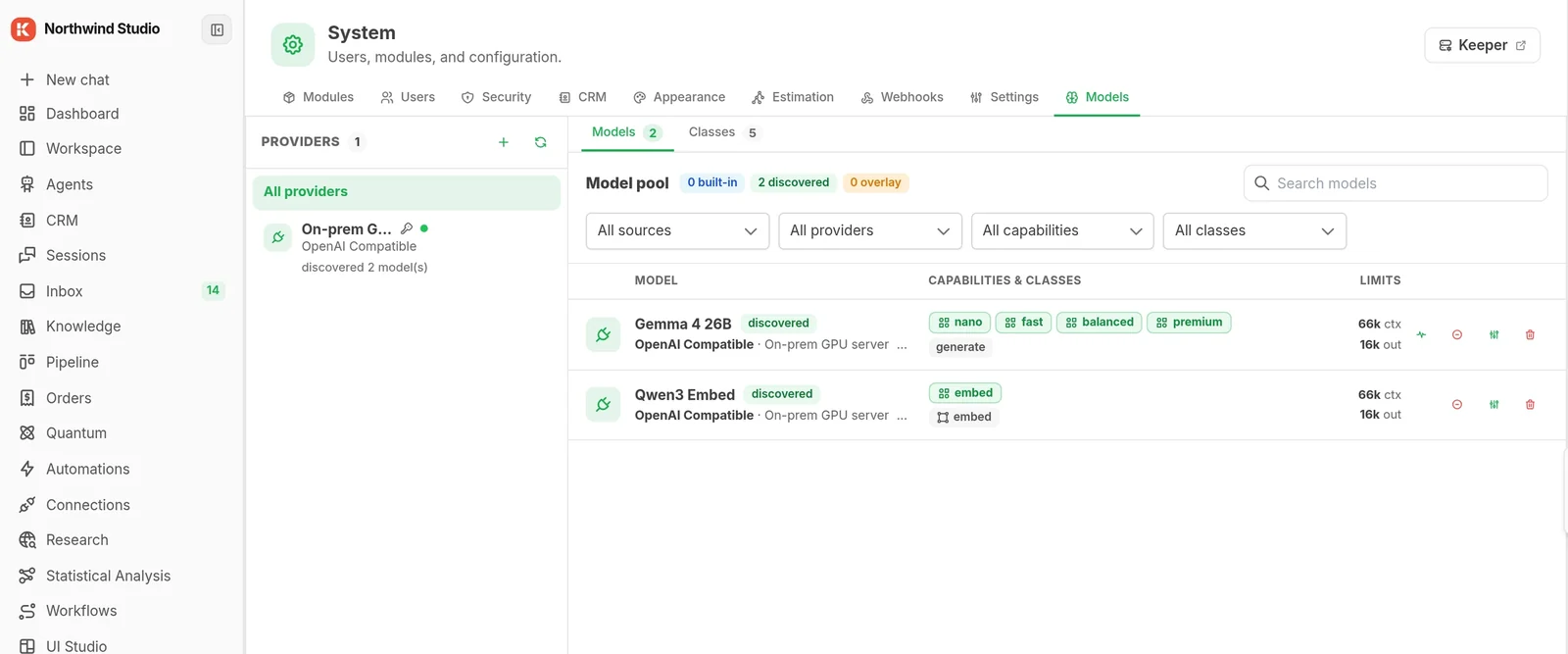
This is the whole architecture on one page. Print it and hand it to whoever owns your vendor review.
Your own copy. There is no shared database holding your records next to someone else's.
A written term in the contract, not a line in a policy page that can be edited later.
You connect the provider and pay them directly. We don't hold, proxy or mark up your usage.
Read it in your own environment, any time, without asking us to run an export.
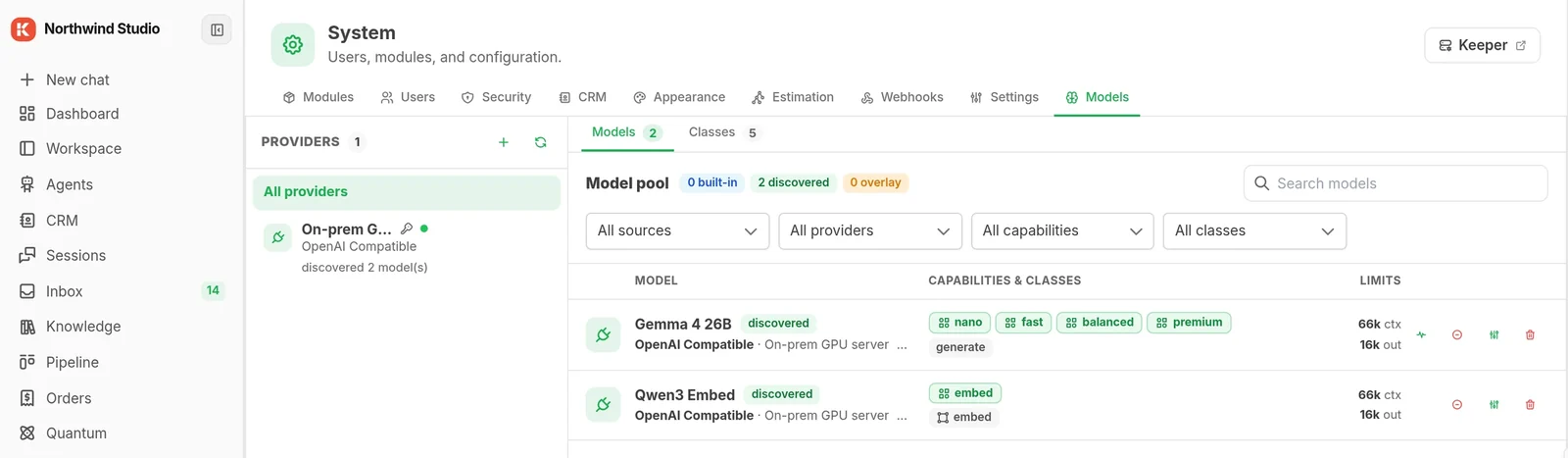
Here a self-hosted GPU provider is connected on an internal address, with a default model picked for each capability. Ollama, LM Studio and vLLM sit next to hosted providers, and the step can be finished later under System, Models.
Every run writes one of these, in your environment, where your own people can query it. This is a single entry from an overnight automation.
Illustrative entries. The shape and the fields are real; the values are not from a customer.
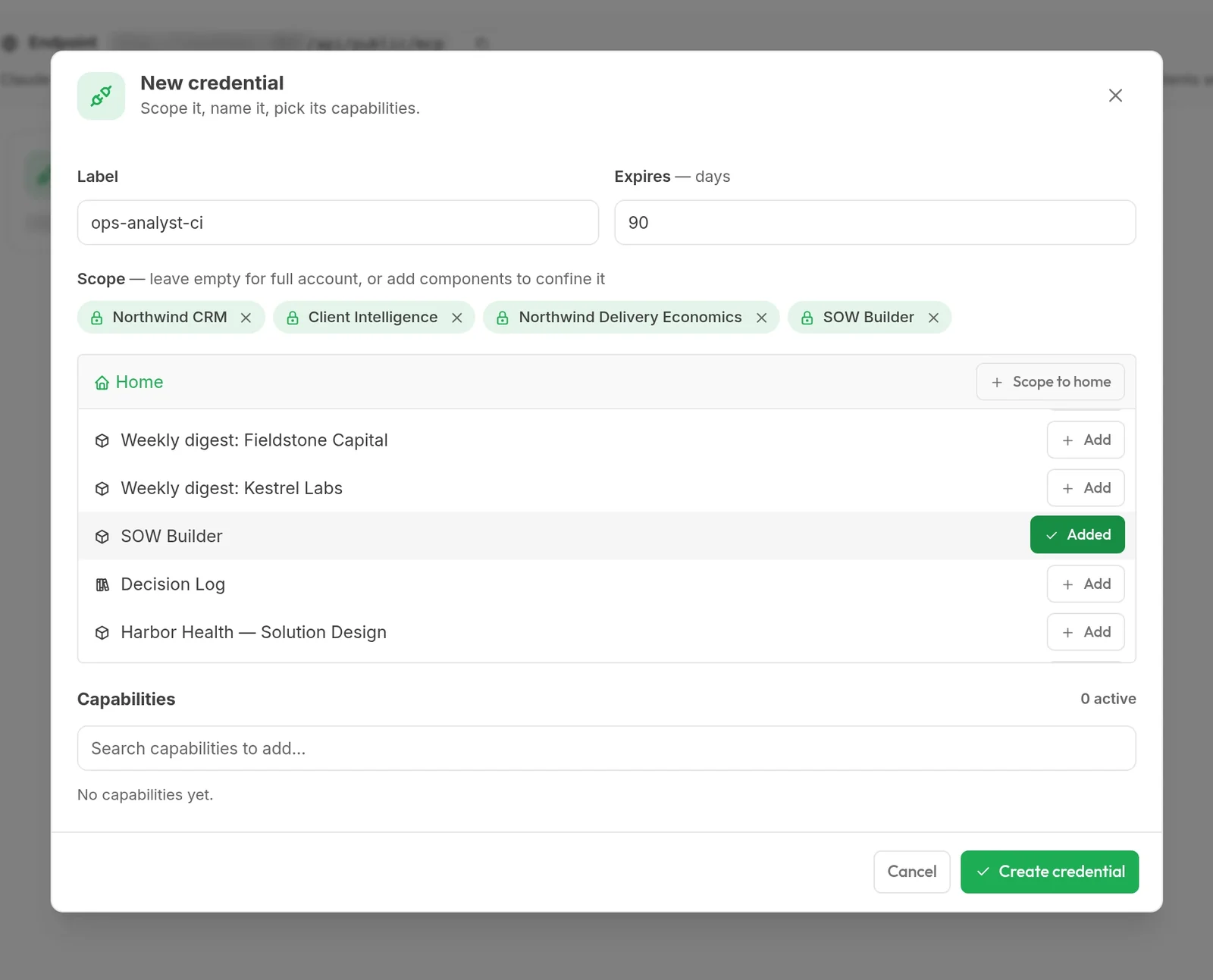
Connecting Claude or another MCP client needs a token issued from your copy. The setup token carries your full account access; issue narrower ones under MCP, confined to named records, knowledge bases and workflows, with an expiry. Each token is shown once and can be revoked.
Most tools fail this review on the first question. This one is built to be read by the people asking it.
Nowhere. It stays on your servers or in your cloud account. Nothing passes through ours unless you choose managed hosting, and then it stays in your own private environment.
Only what you allow. A new agent starts with no access to files, the internet, or other parts of the system, and every attempt is checked against your rules at the moment it is made, not once at setup.
Every action is logged: what ran, for whom, against which record. Your compliance team can read it directly, in your own environment, without asking us for an export.
No. One company per copy. There is no shared environment and no multi-tenant database holding your records alongside somebody else's.
No. Your data, private modules and synced history are never used to train models. Not aggregated, not anonymised. That is a written term, not a policy statement.
You do. You connect your own model provider and pay them directly. We never see your keys and we don't resell or mark up model usage.
Any time, in full. If you ever leave, your copy stays readable for thirty days for export. History sync is off by default, and you can switch it off and delete what it stored whenever you like.
Yes, for any deployment where we host your data. It comes with the first reply rather than after the fourth call.
Ask once and this arrives together, before anyone books a second call.
Uptime commitment, service credits, response times, and the liability terms your legal team will want to mark up.
For any deployment where we hold your data. Sub-processors, retention, deletion, and transfer terms.
The hosted service. Replaced by a signed Platform Licence for companies that need one.
The licence the software itself ships under. Summarised in plain language here.
How permissions, logging and isolation actually work, written for an engineer rather than a buyer. On request.
We have the architecture those audits look for, and we don't have the certificates. We will tell you that on the first call rather than the fourth. If certification is a hard gate for you today, we are not ready for you yet, and we would rather say so than waste a quarter of your time finding out.
Modules from our Hub are not yet cryptographically verified, so a module from any source installs and shows as unverified. If your policy requires signed supply-chain artefacts, that is on the roadmap and not shipped.
This isn't a self-serve tier. Tell us what you're trying to do and where it has to run, and we'll come back with a plan and the paperwork.